
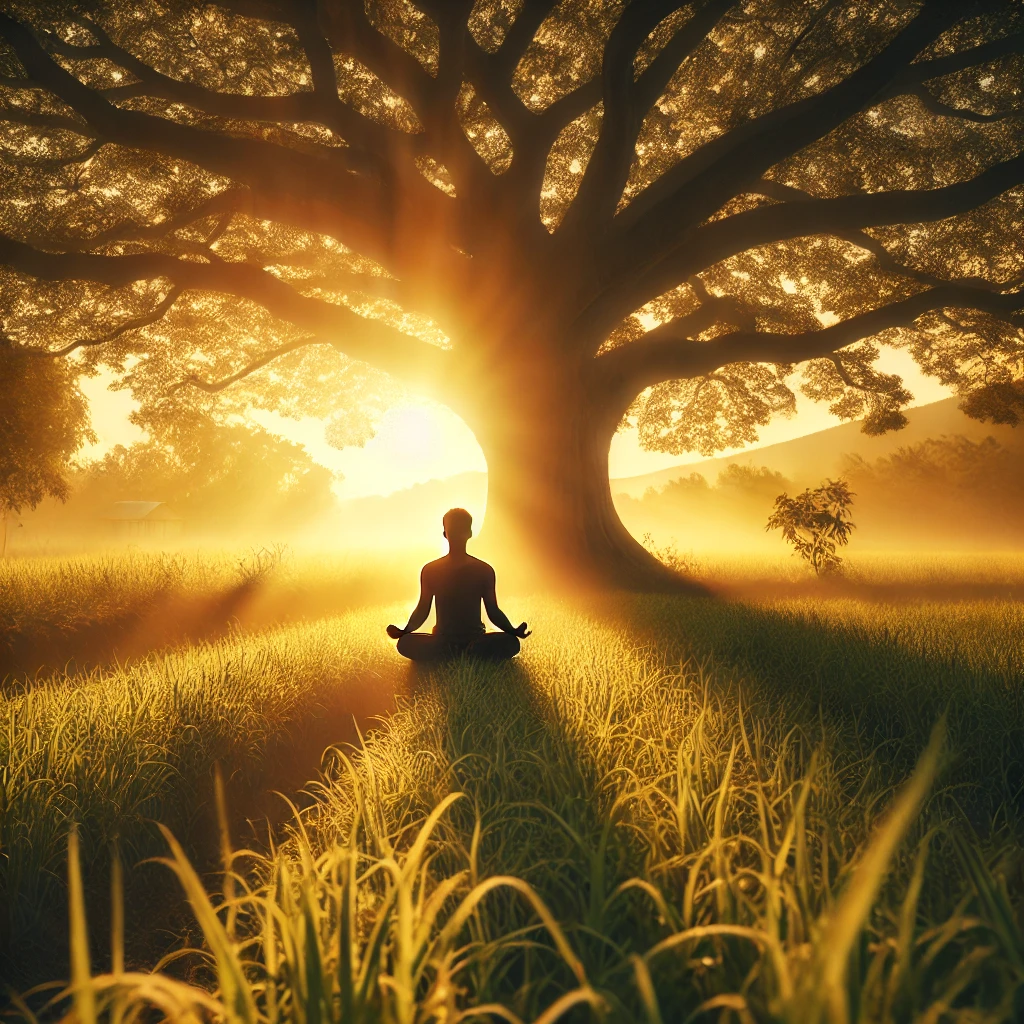
Master Your Destiny: The 4 Purusharthas
From the sacred view of Sanatana Dharma—the eternal way of life—nothing has been left to chance concerning the purpose of being human.
Through states of profound realization and inner knowings, the Rishis of the Vedic tradition have laid out a way of living for people to have both material fulfillment and liberation. This plan is often called the Purusharthas. Purushartha comes from two roots in Sanskrit: Purusha (the soul or consciousness) and Artha (meaning or purpose).
As one, Purushartha means the purpose of the soul’s journey through the human experience. The four Purusharthas—Dharma, Artha, Kama, and Moksha—are not just philosophical concepts, but practical observations of human behavior and existence, to which they apply. These aims are meant to fulfil human needs and desires along an evolutionary scale that includes mental, emotional, physical, ethical, and spiritual needs and aims.
Following the four Purusharthas and systematically understanding each aim provides any individual with an opportunity for full self-realization of their existence, including the ability to shape their destiny.
So, let’s examine the nature and significance of each Purushartha and how they grow and develop into human beings to their fullest possibilities in all aspects of their being—mental, emotional, social, and spiritual.
1. Dharma: The Pillar of Righteousness and Inner Order
At the core of all things is Dharma. It is the first of the four Purushartha and the most fundamental because it represents the right way to live. Dharma is not static morality; it is the law of nature, the principle that sustains the cosmos; it maintains balance in society and within oneself.
Dharma is spoken of as eternal order, encompassing everything around us, in writings such as the Rig Veda and Manusmriti, where even gods abide by Dharma.
“Dharmo rakshati rakshitah”—Dharma protects those who protect it and uphold it. (Manusmriti 8.15)
In this sense, living with Dharma, which can be considered living with truth, duty, non-violence, compassion, discipline, etc., is a life aligned with cosmic intelligence.
Dharma is fluid and contextual; what is right for a student is not right for a warrior nor a renunciant. The Bhagavad Gita focuses on Svadharma—one’s own Dharma—encouraging each to take on responsibility and sincerely and ethically play a unique role in life.
Dharma is the source of responsibility, integrity, compassion, and humility, and is the ethical basis of everything you do. Without Dharma, the other Purusharthas—Artha and Kama—are ultimately chaotic, exploitative, and result in suffering. With Dharma, everything we do has the nature of being sacred.
In personal growth, Dharma shapes individuals’ character and conscience. It encourages making decisions not from selfishness but with an awareness of a person’s duty, fairness, and the greater good. A Dharma-based individual becomes a stabilizing influence in their family, community, and nation. From a spiritual aspect, Dharma is the basis on which an individual can achieve liberation (Moksha).
2. Artha: The Responsible Pursuit of Wealth and Purpose
Artha means material benefit, prosperity, and purpose. It means not only money, but anything of value or sustenance- home, education, skills, relationships, career, and more! No one wants you to die without food or shelter, etc. Artha is not “worldly” or “inferior”; rather, the opposite, it is bulwarked in the Vedic tradition, as long as it has ethical dimensions to it and a connection with Dharma.
The Atharva Veda declares:
“Let wealth come to us from every direction, pure and satisfying, accompanied by Dharma.”
Artha is often necessary for survival, security, and decent dignity in life. Furthermore, Artha enables one to meet responsibilities like raising a family, supporting a community, helping others in need, and improving one’s intellectual and social situation. But Artha can never be an end, or an aim, in and of itself.
The Vedas and the epic Mahabharata emphasize this point regarding attachment to wealth, excessive or incongruent, which makes one greedy, fearful, and loose, despite the numerous peaceful alternatives to wealth that are available.
In this regard, the Arthashastra, one of the ancient texts by Chanakya, documented a meticulous regime of government, economy, and administration that speaks to how important Artha was for a robust society. However, implicit in the pragmatic Arthashastra is the foundational involvement of Dharma.
3. Kama: The Sacred Fulfillment of Desires and Joy
Kama, which is usually referenced narrowly as sensual pleasure, is actually reflective of many of the pleasant experiences in life, including joyful relationships, beauty, art, and an appreciation for our emotional-spiritual body.
The impulse for love, passion, creativity, expression, and enjoyment brings our life force into the body and enlivens the human experience. In the Vedic world, Kama is more than a politician; it is divine.
Kama is personified in the deity Kamadeva, the personification to which we are attracted and in harmony with creation. The Kama Sutra is a spiritual guide about much more than just sex, it defines intercourse as divine union of Shiv and Shakti.
It, together with man’s emotional and aesthetic considerations, would treat on aesthetics and emotional intelligence, the ethics of relationships, and the connection to human beings! The Taittiriya Upanishad declares that the ultimate goal or reality of the Para Brahman, is Ananda – bliss.
Essentially, Kama in its purest form translates to Cosmic bliss. It is the bliss of music, dance, poetry, companionship, family, flora, and fauna. Just like Artha, Kama must be pursued with Dharma as our Charioteer.
It is unfortunate that, when unregulated, Kama can also result in lust, addiction, obsession, and degradation when not regulated, as observed in so many instances throughout texts like the Mahabharata and Puranas.
However, when we are in union with Dharma and influenced by the awareness of self, it brings forth a fabulous element of human development by developing emotional depth, sensitivity, emotional empathy, and connection.
When a heart is whole, the mind can remain balanced, which will help lay the ground for spiritual evolution. The beautiful aspect of Kama is how it can raise one’s life from mere survival to celebrating!
4. Moksha: The Final Liberation and Self-Realization
The fourth and last Purushartha is Moksha—liberation from ignorance (avidya), from the ego (asmita), and our earthly attachment to life and death (samsara). In the Indian philosophical tradition, Moksha signifies the union of one’s consciousness with the eternal, pure, and limitlessness of consciousness (Sat-Chit-Ananda), the true nature of our self.
The Chandogya Upanishad says:
“Tat Tvam Asi” — Thou art That.
This Mahavakya (great saying) represents the heart of Moksha— the soul is not different from Brahman, the supreme reality. However, the soul, because of ignorance (avidya), identifies with the body, mind, and feelings, which creates suffering and bondage. Moksha is not attained by achieving things externally; Moksha is realized internally through waking up, meditating, and relinquishing the ego.
The Bhagavad Gita refers to the liberated human being as “Sthitaprajna”—one who has steady wisdom unshaken by sorrow or joy, detached from outcomes, and finding rest in the Self.
Importantly, we must understand that Moksha does not necessarily have to be the abrogation of worldly life. It can be realized in the heart of worldly life so long as actions are performed as detached actions and inner renunciation, much like Janaka, Yajnavalkya, and Krishna lived, inwardly free while in the world.
When considered through the lens of self-development, Moksha represents the full blooming of inner peace, unconditional love, equanimity, clarity, and freedom. It signifies the highest level of human evolution, where all fears fall away and the soul rests in blissful oneness with the cosmos.
The Holistic Harmony of the Four Purusharthas
One of the most remarkable elements of the Vedic perspective is that the four Purusharthas are not independent of each other; they depend on each other.
Taken together, they offer a comprehensive and balanced model of life for humans:
- Dharma provides the scaffold to give our life an ethical structure and more significant meaning.
- Artha gives us the tools and means by which we can engage in an action in the world.
- Kama brings joy, bliss, connection, and passion.
- Moksha gives us inner freedom and ultimate satisfaction.
To pursue only Moksha without Artha and Kama may bring about a state of imbalance, and a love of detachment from the responsibilities of living a life. To seek only Artha and Kama, without Dharma, without Moksha, leads only to suffering and being stuck in the walls of our ego and desire.
For a human being to be a person of integrity and ethics, to prosper responsibly, to experience unconditional love, and to wrestle with their spirituality. The ashrama system (the stages of a human’s life) found in Sanatan dharma (Hinduism) also illustrates this path:
- In Brahmacharya (student), a student sticks to Dharma and learning.
- During Grihastha (householder), one experiences Artha and Kama within the structure of Dharma.
- While in Vanaprastha (retiree/retired), one begins to withdraw and turn inward.
- And Finally in Sannyasa (renunciation), one becomes a person who only pursues Moksha( liberation ).
This way of living recognizes and honors all human experiences and gives us a step-by-step metric for phenomenological development towards wholeness and enlightenment.
How the Purusharthas Develop the Individual Fully
Aligning with the four Purusharthas changes a person on every level:
- On a physical level, a person becomes healthier and disciplined by living responsibly and taming their desires, usually within the group or family unit.
- A person becomes focused, ethical, and emotionally intelligent on a mental level.
- On a social level, a person contributes to family, society, and the world with integrity and compassion.
- On a spiritual level, a person evolves from ego-centered living to soul-centered awareness.
Dharma, Artha, Kama, and Moksha create a fully developed, spiritually-aligned, socially responsible, emotionally fulfilled, and materially secure human being, which is the ideal visualized in Vedic culture. The goal is not to transcend life, rinsteadit teaches one how to wake up to the fact that life is a sacred opportunity.
This is why the Purusharthas are the cornerstone of Indian culture, spirituality and psychology, providing an example to follow in our quest to manage our destiny.
Conclusion: The Divine Architecture of Human Life
To be the master of your destiny is to know and abide by the divine structure shared with us by the sages, which is known as the Purusharthas. These four aims of man are not constraints to limit us, but liberating conventions that change every action, desire, and predicament into a pathway to enlightenment.
In a world which is often divided between materialism and nihilism, the wisdom shared by the sages in the Purusharthas encourages us to practice a middle way of harmony and significant purpose.
The Purusharthas remind us we are not here just to survive this lifetime, but we are here to unfold, express, serve, love, connect to each other, and eventually merge with the Infinite. When we act in Dharma, acquire Artha, engage in Kama, and strive for Moksha, we are not escaping life; we are exaltating it. This is the Vedic promise: to live a well-lived life is to live a life that is liberated.
Related Reads from Jnanasya
– Prana
– Chitta
– Artha
Check out this YT video – https://www.youtube.com/watch?v=clGV8OfbPwc
Leave a Reply