
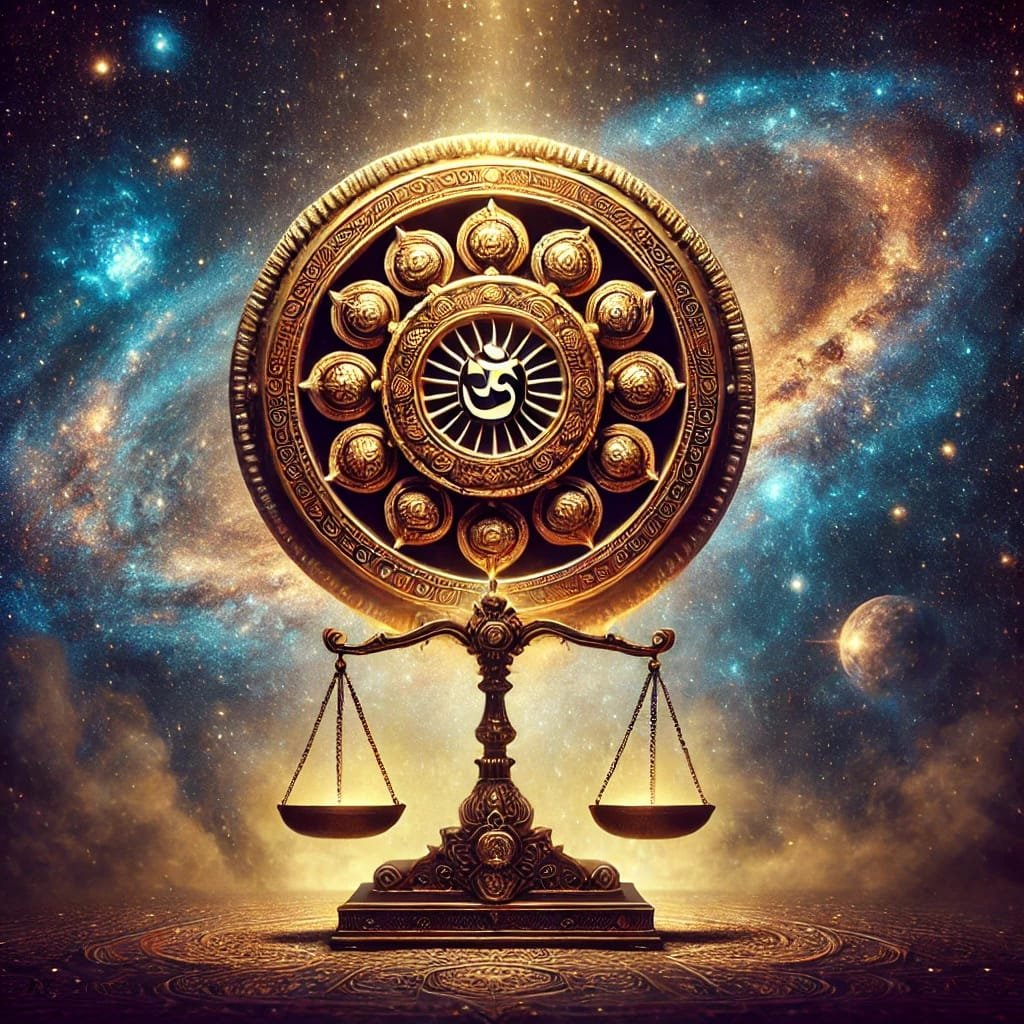
Karma. A word that is as ancient as the Vedas, yet has as much relevance today as it did thousands of years ago, and yet every day, karma takes on an incredibly cavalier meaning in the modern spiritual lexicon. “Karma will get him,” “that’s my karma,” or “what goes around comes around” are casual phrases we hear daily. Very few understand the depth of metaphysical precision and spiritual intelligence that karma, as a concept, truly represents.
Karma is not the modern concept of poetic justice, nor is it a form of cosmic revenge. Karma is a universal law—a dynamic principle of cause and effect that is interwoven into the fabric of existence. This guide will explore what karma is, how it works, the different layers of karma, the different types of karma, and what karma means to human existence and spiritual evolution.
The Etymology and Essence of Karma
“Karma” in Sanskrit is derived from the root word “kri” which means “to do,” or “to act.” Karma is action, but it is not just any physical action. Karma includes thought, intention, emotion, speech, and energy. With each conscious act, we create an imprint on reality, an imprint which presents a vibrational signature that starts a process of causation. In the grand orchestra of the universe, karma is Law, namely the Law of Rhythm, Balance, and Reciprocity.
For the Vedic and Upanishadic perspective, karma is a natural law basic to the function of reality similar to the law of gravity. As an example, throwing a stone up will cause it to come down, regardless of intention (love, greed, hatred, or compassion). Karma is the same thing. Karma will produce an associated result. The results may not appear immediately, yet a result is inevitable.
Threefold Classification of Karma
India’s sages grouped karma into three basic kinds, establishing the karmic cycle that binds the soul to Samsara (the cycle of birth and death):
1. Sanchita Karma – The Accumulated Storehouse
Sanchita Karma is the total karma of all previous lives, a vast pool of actions taken across innumerable lives that has yet to ripe. Not everything is experienced at the same time, some of it is activated in each life. A helpful way to imagine karma would be as a cloud storage of karmic seeds, some are sandwiched between the records of lives, and some are already prepared to sprout. These karmas are the outline of the bigger picture of your soul’s purpose.
2. Prarabdha Karma – The Executed Portion
Prarabdha Karma is the active karma that is ready to be experienced in the present incarnation. It determines the birth conditions, including family, country, health, body, intelligence, and significant life events too. That we face over the span of our lives and are often unexplainable.
One cannot prevent this karma, but can definitely reduce or increase its intensity. Even an enlightened being, once incarnated, must live through their prarabdha karma. However, realization frees them from attaching to or identifying with the suffering it brings.
3. Kriyamana Karma – The Active, Current Karma
This is the karma which one is currently making by their concious or unconcious choices, intentions, and deeds. It is the most important since it determines your destiny and can even change your Sanchita karma.
Kriyamana karma is similar to spreading seeds. You may not see the results right away, but each seed will eventually produce fruit with time—sweet or bitter depending on its nature.
The Law of Cause and Effect: The Engine of Karma
Karma functions according to the law of cause and effect, also known as karma-phala siddhanta. Every deed (karma) yields a matching result (phala). However, unlike physical cause and effect, karmic consequences do not always occur immediately. It just occurs when it is the right time for it to occur. They may appear throughout multiple lifetimes.
Karmic consequences are governed by three primary factors:
1. Intention (Bhava or Sankalpa)
In the Bhagavad Gita, Lord Krishna emphasizes that intent is the source of karma. An action performed with evil purpose carries a greater karmic weight than one performed in ignorance or neutrality.
For example, inadvertently walking on an ant and intentionally murdering it both result in death—but the karmic weight varies greatly.
2. Consciousness of the Doer
Individuals’ level of consciousness matters a lot. A youngster acting in ignorance will generate different karma than an adult acting out of purposeful desire. Similarly, a realized master transcends personal karma since his or her acts are motivated solely by consciousness rather than the satisfaction of one’s ego.
3. Context and Impact
Let’s imagine Karma as a being which operates with conciousness, it considers the circumstances as well as the results. Stealing a loaf of bread to feed a hungry child is and will be karmically distinct from stealing to accumulate wealth.
Karma does not use a binary moral system; instead, it considers subtlety, vibrations, intents, and the overall energetic footprint of an act.
Types of Karma: The Yogic Perspective
The Yogic and Vedantic traditions goes deeper into classifying karma based on its nature and outcome:
1. Nishkama Karma – Desireless Action
This is the most pure type of karma, as it is performed without regard for the end result. The Bhagavad Gita states that acting with equanimity, regardless of success or failure, leads to spiritual emancipation or liberation.
The path of karma yoga purifies the heart and destroys karmic bonds of any type, even Prarabdha Karma.
2. Sakama Karma – Action with Desire
Actions that are motivated by wants, desires, expectation, or ego further binds the soul to Maya. These karmas leave impressions (vasanas) in the subconscious mind of an individual. Which further influences the behavior of the indivudial, creating a chain of cause and effect which ends up effecting us to the point of our atman’s reincarnation.
3. Vikarma – Prohibited or Negative Actions
These are destructive activities or actions that violate dharma (one’s code of righteousness). They have terrible repercussions and cause profound karmic entanglements in which our Atman stays stuck for cycles until it attains moksha (liberation).
4. Akarma – Inaction or Non-Doership
Akarma, is not to be mistaken with lazyness or inactivity, is the state of a realized being acting without ego. Though actions take place through the persons body and mind, yet they remain unaffected, like a lotus leaf in water.
The Mechanism of Karma: How It Actually Works
Let’s explore the metaphysics of karmic transmission. How does Karma “know” what to do? Where is it stored? How does it manifest?
1. Karmic Impressions (Samskaras and Vasanas)
Every action has a subtle impression, known as samskara, on the subtle body (sukshma sharira). These imprints produce behavioral patterns, or vasanas, which are unconscious urges that guide thoughts, emotions, and judgments.
These vasanas evolve over time, attracting situations, people, and events that correspond to their periodicity. Thus, your inner world literally shapes your external reality.
2. Chakra and Energy Body Influence
The seven chakras function as psychic centers where karma is processed and expressed. For example:
- Root chakra: karmas related to survival and fear
- Heart chakra: love, betrayal, grief
- Throat chakra: truth, communication karma
- Ajna chakra: karma of misuse of spiritual power or vision
Blocked chakras often indicate unresolved karma from past lives or this life.
3. Cosmic Intelligence and Divine Will
While karma is impersonal in nature, it works within the vast orchestration of the ParaBrahman (The Cosmic Consciousness). Karma isn’t punishment; It is just a consequence of what one does in their lifetime. The Divine is not seeking vengeance, but rather growth and clarity. It’s like The Parabrahman is indulged in Maya, in different forms ,in the pursuit to find himself. Each karmic incident serves as both a mirror and a teacher, leading you back to your original essence, i.e the essence of the Parabrahman.
Karma and Rebirth: The Cycle of Samsara
When the soul departs from the physical body, it conveys its karmic blueprint—the vasanas and samskaras—to the next incarnation. Based on these karmic obligations and lessons, it takes birth in circumstances that create the ideal environment for progress.
Thus, reincarnation is not random, but rather precisely planned by the cosmic energy to achieve balance, justice, and advancement. Leading to the ultimate goal which is Moksha.
Can Karma Be Changed?
Yes and no. Rather the answe to this question is not so simple.
- Prarabdha karma, like an arrow discharged from a bow- it must complete its arc.
- But Kriyamana karma has an enormous potential. Through conscious living, spiritual practices, and complete surrender to the Parabrahman can cleanse the mind, weaken vasanas, and even burn dormant karmas.
Tools to Transform Karma:
- Selfless Service (Seva) – Destroys ego and generates positive karmic merit.
- Mantra and Japa – Reprogram the vibrations of the subtle body with Matra chanting.
- Meditation – Burns samskaras in the fire of awareness.
- Forgiveness and Compassion – Helps in dissolving karmic knots with others.
- Grace (Kripa) – The Kripa of the Supreme Consiousness can override karma through blessings and spiritual merit.
Beyond Karma: Moksha, The Final Liberation
Karma merely binds the ego-identified soul. When one understands their true Self—not as the body, mind, or even the doer—but as pure Atman (awareness), karma loses its hold.
Such a person may continue to experience karmic occurrences, but they are no longer reactive or attached. They become jivanmuktas, or emancipated while living. For them, the cycle has ended. Karma vanishes in the light of self-awareness.
Final Thoughts: Living with Karma Consciously
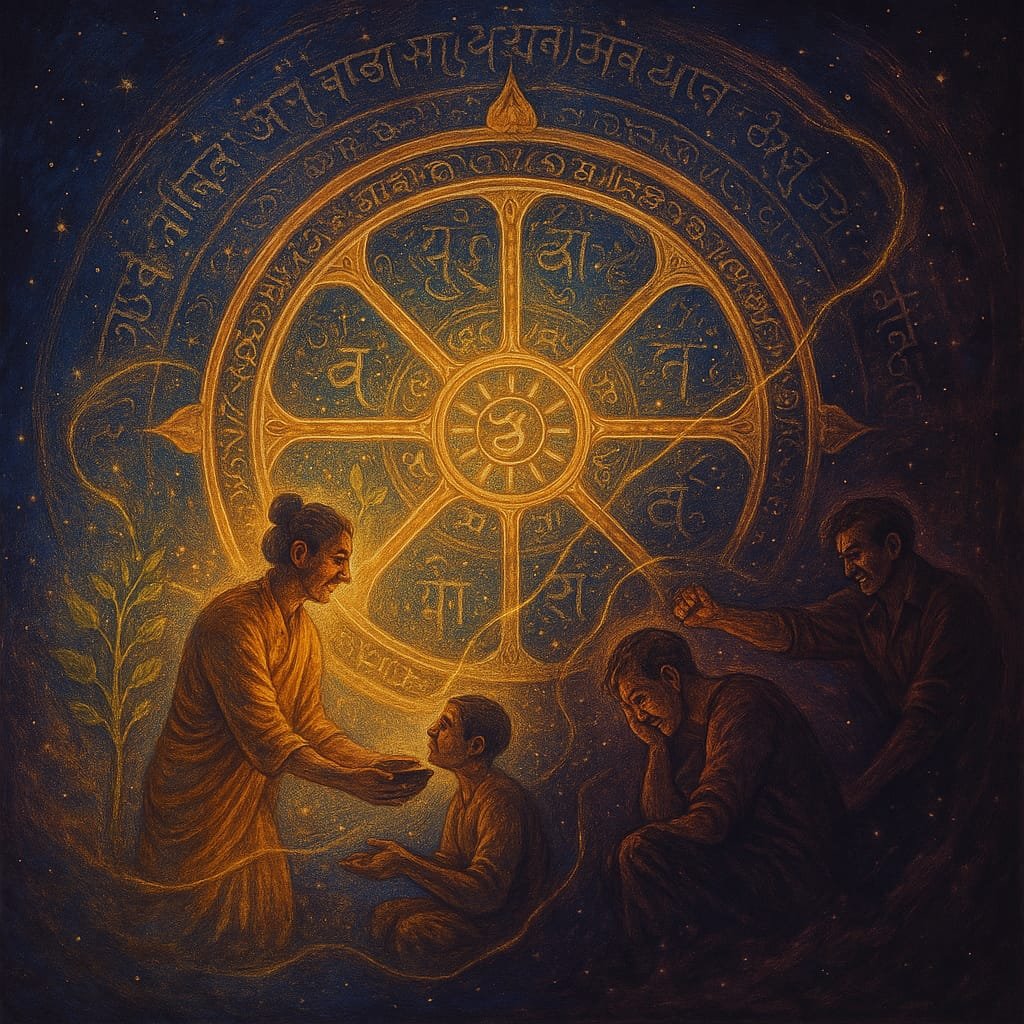
Karma is frequently misunderstood as a system of retribution or reward, whereas in reality it is a divine wisdom which aligns with balance and progress. It does neither punish or applaud; it just reflects. Karma is a mirror, not a judge. It provides the most accurate reflection of who we are and where we are in our soul’s journey. Every encounter, whether joyous or sad, invites us to awaken—to watch, learn, and grow.
Everything changes if we see karma as a tool for conscious progress rather than fate. We stop reacting and begin responding. We no longer see challenging circumstances as curses, but rather as specialized lessons provided by the cosmos to help us understand our actual nature and to help us grow.
When we become conscious of our karma, we recover our power. Every thought, purpose, and action you take becomes a seed. With that awareness, you get the ability to plant consciously—by choosing love over fear, truth over illusion, and selflessness over ego. Life ceases to be random and becomes a hallowed field of spiritual agriculture, where you seed, what you intend to reap.
Living in karmic awareness transforms everyday existence into a spiritual exercise. The way you communicate with others, how you deal with adversity, even how you handle money or food—all become offerings, opportunities to connect and align with dharma (the cosmic order).
The Rishis have always lead us from karma (activity) to dharma (righteous behavior), and finally to moksha (freedom). Karma is not the end; rather, it marks the beginning of mindful living. When conducted selflessly and directed by inner knowledge, karma becomes a bridge to transcendence and attain liberation. This is the sacred art of karma yoga: behaving without attachment and dedicating each deed to the Parabrahman.
As you align your acts with compassion, truth, and service, your karmic knots start to unravel. Slowly, the wheel of Samsara begins to slow down. And one day, you arrive at the peaceful center, where there is no doer, deed, or karma. Only pure consiousness.
True freedom is obtained not by escaping karma, but by transcending it through consciousness and dharma. The more mindful you become, the more you dissolve the unconscious patterns (vasanas) that motivate you. Meditation, self-inquiry, seva (service), mantra, and surrender are all flames that consume the seeds of Prarabdha (pending) karma before they germinate.
The ultimate goal is not to accrue good karma, but to transcend it entirely—to live in such serenity and surrender that the waves of cause and effect do not disturb the Self.
Remember ! You Are Not Your Karma
It’s crucial to realize that you’re not your karma. You are not the actions, outcomes, traumas, or patterns. You are the eternal witness, the Atman, unaffected by deed or outcome.
Karma is an aspect of the body-mind, which serves as a conduit for experience. The true “you” is the one who observes everything—the unchanging light of awareness, beyond birth and death, merit and sin.
In that realization lies the ultimate freedom.
“कर्मण्येवाधिकारस्ते मा फलेषु कदाचन।
मा कर्मफलहेतुर्भूर्मा ते सङ्गोऽस्त्वकर्मणि॥“
(Karmaṇy-evādhikāras te mā phaleṣu kadāchana,
Mā karma-phala-hetur bhūr mā te saṅgo ’stvakarmaṇi.)
“You have the right to perform your prescribed duties,
but you are not entitled to the fruits of your actions.
Never consider yourself to be the cause of the results of your activities,
and never be attached to not doing your duty.“
Check out this YouTube video: https://youtu.be/zO8QzMWZbN4?si=6PZhIFQywsG2UzRC
Check out more of my works: Prana: The Divine Energy Within
Leave a Reply